
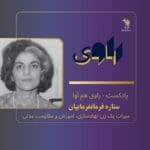

In this episode, we explore the life of a woman whose name may not be very familiar to today’s generation, yet her impact is still present in Iran’s social fabric—even if her name has been removed from textbooks.
Setareh Farmanfarmaian, a woman from one of Iran’s most powerful political families, could have stayed within the safe and aristocratic circles like many others,
But she chose to step outside that circle and go to the poorest neighborhoods;
A woman who chose her path not based on “family expectations” but on “social awareness.”
In this podcast, we discuss her childhood in the confined space of the harem;
Her journey during World War II that took her to the United States;
Her return to Iran and the founding of the first school for social work;
Her escape from the threat of execution during the early days of the Revolution;
And how she saw social service as a form of civil resistance until the final years of her life.
Most importantly, we explore the message this winding path holds for the women of Iran today.
For a more precise narrative, we rely on two main sources:
First, excerpts from her 1992 audio interview with NPR – Fresh Air;
Second, documented information and personal accounts in the book Daughter of Persia, as well as recordings of Setareh Farmanfarmaian’s voice in an interview with Azadeh Davachi on the occasion of her 90th birthday.
The Ravi–Ham-Avā podcast series aims to expand the national discourse around universal values, democracy, the separation of religion and state, human rights, gender equality, and the preservation of Iran’s territorial integrity.
Within such a framework, we can move along the path of collective wisdom toward a free and dignified Iran—for all Iranians, regardless of belief, thought, gender, ethnicity, or background.
“Government of the people, by the people, and for the people.”